All items of category 'Behavioral Health'
Strategies, tools, and resources regarding emotions and behaviors that impact overall wellbeing.

The Open Doors Training project is a comprehensive training designed to empower non-clinical, youth-serving adults across California by equipping them with additional skills and knowledge to engage with young people on topics related to substance use and other behavioral health issues. This training is ideal for adults in who interact with youth, including educators, community leaders and volunteers, child welfare workers, and other non-clinical professionals.
Youth Mental Health First Aid (YMHFA) is a free, evidence-based training for adults on how to identify, understand, and respond to signs of mental illness and substance use disorders in youth. This training gives adults the skills they need to reach out and provide initial support to children and adolescents (ages 6-18) who may be developing a mental health or substance use problem and help connect them to the appropriate care.
Join us for a webinar spotlighting three new digital applications designed to support the behavioral health of youth and young adults in California. Funded through the Children and Youth Behavioral Health Initiative (CYBHI), each app—Mirror, Soluna, and BrightLife Kids—was designed with input from the audiences they aim to serve. Clinical, school-based, and community care team members will gain valuable insight into services offered by each app and, more specifically, how Soluna and BrightLife Kids can be integrated into care pathways, ...

The Becoming ACEs Aware in California training is a free, two-hour, online course that covers Adverse Childhood Experiences (ACEs), toxic stress, ACE screening, toxic stress risk assessment, and trauma-informed care and provides health care teams and community providers with evidence-based strategies to prevent and mitigate toxic stress physiology. Updated in 2026, the training includes tailored learning pathways for Medical Providers, Mental and Behavioral Health Providers, and members of the broader Care Team. The training offers between 2.0 and 9.0 free Continuing ...

The California Department of Public Health, Office of School Health, the California Department of Education, and subject matter experts have developed this no-cost, online 50-minute training to provide information on how school staff, as trusted adults, can support the social, emotional, and physical well-being of students by creating learning environments where students feel safe, accepted, and valued. This training is aligned with the requirements of California Education Code Section 49428.2(c) and welcomes participants into a community of staff that can ...
These dyadic documentation templates provide examples of how dyadic care services may be documented in accordance with the guidelines outlined in the California Department of Health Care Services (DHCS) Non-Specialty Mental Health Services (NSMHS) Manual (last updated January 2025) and are intended solely for educational and training purposes.
This webinar focuses on the revision of an American College of Surgeons trauma-informed care curriculum that was implemented, tested, and revised to educate Zuckerberg San Francisco General Hospital health care workers. Trauma-informed care is an approach that considers patients’ lived experience and current circumstances to provide respectful, patient-centered care. Participants will hear about how this team used human-centered design principles to revise the curriculum, train trauma-informed health care workers, and promote a trauma-informed hospital ecosystem.
This webinar, part of the ACEs Aware Science and Innovation Speaker Series, features Dr. Nicole Racine and Katelyn Greer, who will present on “Youth Engagement in Child Maltreatment Research: Gaps, Barriers, and Approaches.” They will provide an overview of the potential for youth engagement within the field of child maltreatment research, identify barriers to youth engagement, provide trauma-informed strategies for engaging youth in the context of research, and review existing trauma-informed models for youth engagement.
This webinar will feature a University of California San Francisco (UCSF) pilot project focused on the use of trauma inquiry in family planning sessions. Adverse Childhood Experiences (ACEs) and traumatic experiences, such as intimate partner violence (IPV), impact health outcomes of people seeking family planning services. IPV and sexual assault are more common among people with sexually transmitted infections and people seeking abortion care, yet trauma is not routinely discussed in family planning settings. Clinical cases will be used to ...

This webinar, part of the ACEs Aware Science and Innovation Speaker Series, features Dr. Joanne Ryan, who will present on “Biological Embedding of Early-Life Adversity and a Scoping Review of the Evidence for Intergenerational Epigenetic Transmission of Stress and Trauma in Humans.” Dr. Ryan will provide an overview of studies that demonstrate the impact of early-life stress on DNA methylation and the biological transmission of stress across generations.
In this Community Spotlight webinar, we feature the National Foster Youth Institute (NFYI), which is a national nonprofit that works to empower current and former foster youth to use their lived experiences to tackle issues that most impact vulnerable children, families, and young adults. Los Angeles County is the largest child welfare system in the nation, and members of NFYI’s Los Angeles Chapter will share their lived experience of navigating issues with housing, mental health, justice, parenting, and substance use. ...
As part of the ACEs Aware Science and Innovation Speaker Series, this webinar will feature Dr. Joan Jeung, who will present on “A Caregiver-Child Intervention for Mitigating Toxic Stress (‘The Resiliency Clinic’): A Pilot Study.” Dr. Jeung will discuss a novel primary care-based group intervention designed to mitigate toxic stress and promote resilience in children exposed to Adverse Childhood Experiences (ACEs).

This webinar, part of the Clinical Pilots series, focuses on a trauma-informed diabetes intervention program that screens for Adverse Childhood Experiences (ACEs) within a safety net family medicine clinic. Participants will learn about diabetes as an ACE-Associated Health Condition, the methods and findings of this diabetes pilot, and how an ACEs and trauma-informed approach for diabetes management can supplement usual care.
This webinar, part of the ACEs Aware Science and Innovation Speaker Series, features Dr. Cody A. Hostutler, who will present on ACEs Screening in Adolescent Primary Care: Psychological Flexibility as a Moderator. Dr. Hostutler will discuss the role of psychological flexibility in moderating the effects of Adverse Childhood Experiences (ACEs) on depression and body mass index (BMI) in adolescents.
This webinar, part of the Implementation with Intention series, will explore how Enhanced Care Management (ECM) can enhance comprehensive care coordination and link families to community and social service needs. Participants will review the new pediatric ECM Medi-Cal benefit and discuss opportunities to sustain this benefit to promote the health and well-being of Medi-Cal members with the most needs.

This webinar, part of the ACEs Aware Science and Innovation Speaker Series, will feature Rebecca Ferro, who will present on “When Adverse Childhood Experiences Present to a Statewide Child Psychiatry Access Program.” Ferro will discuss the role of child psychiatry access programs in supporting primary care providers with pediatric patients.
This webinar will describe how and why a family wellness program that provides navigation and care coordination for the children of adult primary care patients was designed and implemented to mitigate intergenerational trauma at the UCSF Women’s HIV Program. Clinical vignettes will be used to illustrate how the program works and impacts the lives of participants. Evaluation data will be shared to demonstrate how the program has been adapted based on patient and provider/staff feedback and experience. Ideas and practices ...
In this webinar, part of the Implementation with Intention series, participants will explore the opportunity of primary care-based dyadic care for improving child and family well-being. They will review the new dyadic care Medi-Cal benefit and opportunities to pay for health promotion and prevention and explore the intersection between dyadic care and toxic stress prevention.

In this webinar, Dr. Laura Figueroa-Phillips, MD, MSCE, will discuss the beneficial effects of mindfulness and meditation for patients suffering from the effects of Adverse Childhood Experiences (ACEs). Dr. Figueroa-Phillips will give an overview of the existing evidence for these benefits and will share the results from her team’s pilot study, “Virtual Meditation as a Response to Adverse Childhood Events.” Dr. Figueroa-Phillips will conclude by sharing ideas for future projects and resources her team developed to promote mindfulness practices within ...

This webinar, part of the ACEs Aware Science and Innovation Speaker Series, features Dr. Brian Joyce, who will present on “The Association of Adverse Childhood Experiences (ACEs) with Accelerated Epigenetic Aging in Midlife.” Dr. Joyce will talk about how ACEs may be persistently associated with the biological aging process in later life.

This webinar, part of the ACEs Aware Science and Innovation Speaker Series, will feature Dr. Loren L. Toussaint, who will present on “The Association Between Parent and Child ACEs is Buffered by Forgiveness of Others and Self-Forgiveness.” Dr. Toussaint will discuss how self-forgiveness and forgiveness of others may interrupt, or buffer, intergenerational transmission of ACEs.

In this webinar, part of the Implementation with Intention series, ACEs Aware youth and young adult patient advisors will share their recommendations for how health care teams can discuss Adverse Childhood Experiences (ACEs) and toxic stress with young patients. Participants will also hear a clinician's perspective on approaches to addressing ACEs and toxic stress among adolescent patients.
The Office of the California Surgeon General, in partnership with California’s Children and Youth Behavioral Health Initiative, recently launched a campaign to raise awareness and offer resources to youth and young adults affected by Adverse Childhood Experiences (ACEs) and toxic stress. The Live Beyond campaign is grounded in science, market research, and best practice, and was co-created with subject matter experts and youth from the ACEs Aware Youth and Young Adult Advisory Board. Join current and former California Surgeon Generals, Dr. ...

In this course, participants will gain a comprehensive understanding of the causes and manifestations of burnout among health care professionals. They will learn about evidence-based self-care and stress-mitigation strategies they can use to promote personal resilience, as well as strategies health care organizations can use to manage and prevent burnout.

In this webinar, representatives from Alianza Nacional de Campesinas, Futures Without Violence, and Líderes Campesinas will discuss an ACEs Aware pilot project to promote health, leadership, and collaboration between farmworker leaders and community health centers in farmworker communities. Project NACES, built in collaboration with local community health centers and our evaluation partners, aims to increase opportunities for farmworkers to inform health care screening and responses to Adverse Childhood Experiences (ACEs), increase ACEs education in farmworker communities, build partnerships between community ...

The ACEs Aware Clinical Pilots webinar series highlights the work of researchers, health care teams, and community organizations that have received funding from ACEs Aware to advance the field of Adverse Childhood Experiences (ACEs) and toxic stress. The series shares innovative strategies to identify, prevent, and respond to ACEs and toxic stress in different settings and patient populations. Each webinar in this series features specific work to address current gaps in evidence and practice, lessons learned, and implications for the ...

In this webinar, Dr. Candace Gragnani, MD, MPH, will discuss the evidence base for connecting with nature to mitigate toxic stress and improve physical, mental, social, emotional, and spiritual well-being. Attendees will learn how nature can be leveraged as part of a Trauma-Informed Network of Care from two nature-based programs that engage youth at the clinical and community level. Dr. Gragnani will highlight findings from the ACEs Aware pilot project that explored park staff and pediatric health care provider views ...

This webinar focuses on the causes and manifestations of burnout among health care professionals, evidence-based strategies to effectively prevent and manage burnout, and how burnout can be addressed as part of the implementation of Adverse Childhood Experience (ACE) screening and trauma-informed care activities. Participants will learn about self-care and stress-mitigation strategies to promote personal resilience, as well as strategies that health care organizations can use to prevent burnout, focusing on workload, work-life balance, and organizational culture.
This webinar, part of the ACEs Aware Science and Innovation Speaker Series, will feature Dr. Diana Fishbein who will present on “Capitalizing on Neuroplasticity Across Development to Redirect Pathways from Juvenile Justice Involvement”. Dr. Fishbein will discuss insights on how to disrupt an adverse developmental pathway in young people that may lead to incarceration.
This webinar will highlight recently published key findings from the California ACEs Learning and Quality Improvement Collaborative (CALQIC), which was a two-year, 48-clinic, seven-region collaborative that examined the challenges and facilitators to implementing, scaling, and sustaining ACE screening and response in frontline Medi-Cal clinics. Participants will hear from Dr. Edward Machtinger, who co-directed CALQIC (with Drs. Marguerita Lightfoot and Anda Kuo) and Dr. Nicole Eberhart, a Senior Behavioral Scientist at RAND Corporation, a CALQIC evaluation partner. The webinar will describe ...

In this ACEs Aware Science and Innovation Speaker Series webinar, Dr. Rosemarie de la Rosa will present on the paper, “Biological Burden of Adverse Childhood Experiences in Children”. Dr. De la Rosa will discuss the relationship between ACEs and related life events and allostatic load, known as “wear and tear” from chronic stress, in a pediatric population.
This webinar will explore the fundamentals of billing and reimbursement for Adverse Childhood Experience (ACE) screening. Tailored for health care professionals and administrators, participants will learn about the billing cycle of an ACE screen and clinical response and key steps to building a billing workflow. The presenters will share strategies that they have used successfully in clinical settings, with a focus on aligning financial practices with prevention, screening, and treatment for ACEs and toxic stress.
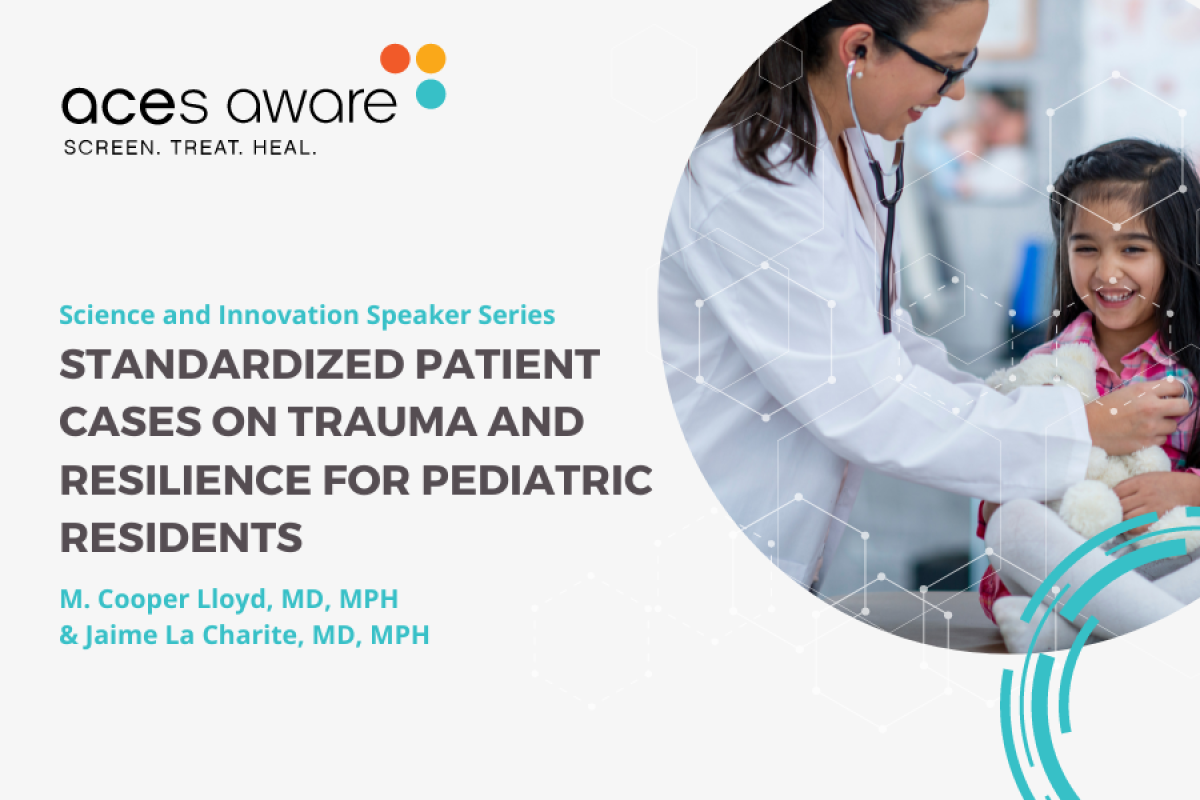
This webinar, part of the ACEs Aware Science and Innovation Speaker Series, will feature Dr. M. Cooper Lloyd and Dr. Jaime La Charite, who will present on the paper, “Addressing Trauma and Building Resilience in Children and Families: Standardized Patient Cases for Pediatric Residents”. Dr. Cooper Lloyd and Dr. La Charite will discuss the creation, implementation, and evaluation of three standardized patient cases to train pediatric residents on how to use trauma-informed principles to talk to patients about Adverse Childhood ...

In this edition of the Implementation with Intention webinar series, participants will learn how to prepare and set up common electronic health record (EHR) systems for Adverse Childhood Experiences (ACE) screening and response. Participants will learn various approaches to EHR builds, how to leverage data systems for referrals within ACEs networks of care, and see examples of actual ACEs builds in specific EHR platforms.

This webinar, part of the ACEs Aware Science and Innovation Speaker Series, will feature Dr. Neeta Thakur and Dr. Danielle Hessler Jones, who will present on the paper, “Pediatric ACEs and Related Life-events Screener (PEARLS) and Health in a Safety Net Practice”. They will discuss the use of the PEARLS tool for identifying and facilitating early detection of and intervention for ACEs in a pediatric setting.

This webinar, part of the ACEs Aware Science and Innovation Speaker Series, will feature Dr. Erin Hambrick, who will present on the paper, “Beyond the ACE score: Examining relationships between timing of developmental adversity, relational health and developmental outcomes in children”. Dr. Hambrick will discuss how the timing of adversity through four developmental stages affects developmental outcomes in children, and how relational health can be a supplemental tool to ACE screening in both evaluating developmental outcomes and serving as a ...

The ACEs Aware Stress Busters: Clinical Strategies for Preventing and Mitigating Toxic Stress course helps health care professionals develop their clinical response to childhood adversity and toxic stress through a comprehensive exploration of seven evidence-based, stress management strategies, called stress busters. This eight-module e-learning course introduces Adverse Childhood Experiences (ACEs) and toxic stress, followed by an in-depth examination of each stress buster. Learners will gain an understanding of the scientific basis behind these evidence-based strategies for regulating toxic stress and ...

The ACE Screening Implementation How-To Guide was developed to facilitate the adoption of ACE screening and trauma-informed care into practice at the organizational level. This series includes: (1) an introductory overview of the How-To Guide, (2) guidance on what is needed clinically, operationally, administratively, and emotionally to begin screening, (3) guidance on key decisions that must be made in selecting your clinic’s approach to implementing ACE screening and treating toxic stress, and (4) resources to create a supportive work environment, ...
This is a special webinar highlighting the final release of the ACEs Aware Trauma-Informed Network of Care Roadmap. The Network of Care Roadmap provides practical steps that health care providers, clinics, community-based organizations, and social service agencies can take within their communities to grow cross-sector networks of care and improve collaboration and coordination across systems to prevent, treat, and heal toxic stress.